🗞️ Steel Trap: A New Jersey Ironworks Learned Too Late That Labor Law Doesn't Wait for a Business to Fail
The NLRB found Forepeak Steel, LLC violated federal labor law by laying off five union ironworkers and closing its New Jersey facility without bargaining with their newly certified union, ordering backpay and effects bargaining.
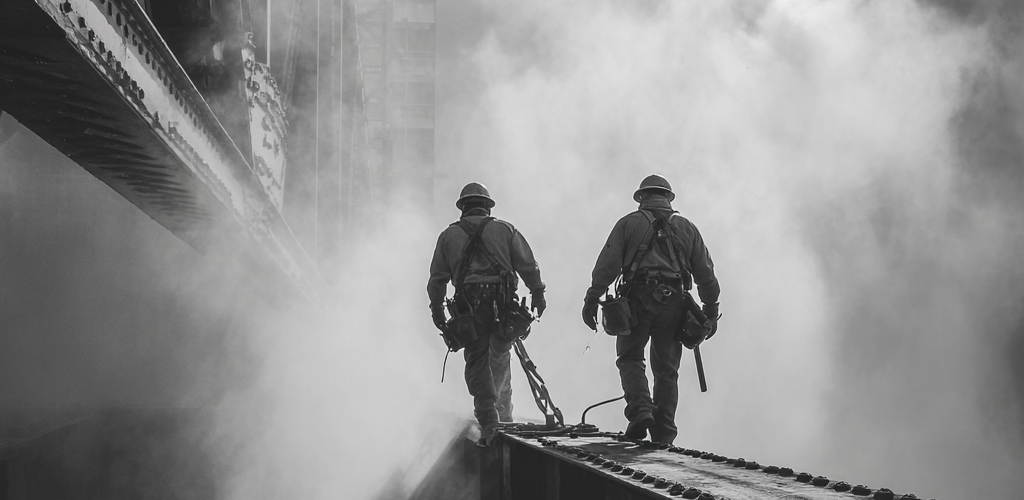
When Camillo Papa called each of his five ironworkers in the spring of 2024 to tell them they no longer had jobs, he probably wasn't thinking about federal labor law. He was thinking about survival. His company, Forepeak Steel, LLC, a small structural steel erection firm tucked into Point Pleasant Borough, New Jersey, was hemorrhaging money, its insurance policies had lapsed for nonpayment, and its bank accounts were chronically overdrawn. The calls, he later suggested, were simply how things had always been done.
That explanation did not satisfy the National Labor Relations Board.
Less than three months before Papa made those calls, the NLRB had certified the International Association of Bridge, Structural, Ornamental and Reinforcing Iron Workers as the exclusive bargaining representative of his ironworker employees, the result of a union vote the workers had taken the previous September. The union had wasted no time. Within days of certification, it wrote to the company requesting the start of contract negotiations and warning that no unilateral changes to employment terms should be made without first affording the union an opportunity to bargain. The company acknowledged the letter. Then, in early April 2024, Papa laid off all five unit employees without a word to the union.
The workers themselves were the ones who told the union what had happened.
What followed was a case study in what labor law experts describe as a compliance failure that small, financially distressed employers are particularly prone to: the mistaken belief that economic crisis suspends the duty to bargain. It does not. Under Section 8(a)(5) of the National Labor Relations Act, an employer's obligation to notify a certified union and negotiate before making changes to workers' terms and conditions of employment applies regardless of the company's financial state. The Supreme Court established in NLRB v. Katz (1962) that unilateral changes to mandatory bargaining subjects, made without notice to the union, constitute an unfair labor practice.
Forepeak's troubles compounded as the year wore on. By July 1, 2024, the company had canceled its employee group health insurance and, by any practical measure, closed its doors. It informed the union of none of this. The union only learned the business had shut when Camillo Papa said so in a terse message on September 5. By then, the union had been locked out of any meaningful role in negotiating how the closure would affect the workers it represented.
There is an important legal distinction embedded in what Forepeak did and did not have to do. Under First National Maintenance Corp. v. NLRB (1981), the Supreme Court held that an employer is not required to bargain over the underlying decision to close a business when that decision is driven purely by economics. Forepeak was off the hook on that count. But the law draws a firm line between the decision itself and its consequences for workers. Severance, health coverage continuation, the timing of a final paycheck: these are precisely the kinds of effects that unions exist to negotiate, and the employer must bargain over them in a timely, meaningful way before implementing the closure, not after the fact.
Administrative Law Judge Michael A. Rosas found, in a decision issued December 9, 2024, that Forepeak had violated the Act on both fronts: the spring layoffs, and the failure to provide pre-implementation notice of the closure. He rejected the company's argument that the layoffs were consistent with past practice, citing the Board's 2023 decision in Wendt Corp., which reaffirmed that practices established before a union's certification cannot be invoked to justify later unilateral conduct.
The full Board affirmed those findings on March 27, 2026, and sharpened the remedy. The five laid-off workers, Troy Griffin, Matt Griffin, Leslie Mann, Jason Chango, and Keith Hesterman, are entitled to make-whole backpay from the date of their April 2024 layoffs through the business's closure in July 2024, with interest compounded daily. They are also entitled to compensation for other foreseeable financial harms from the layoff, including job search expenses, as well as relief for any adverse tax consequences from receiving lump-sum awards. A separate, more limited backpay remedy applies to the effects-bargaining violation tied to the closure itself, calculated under the framework established in Transmarine Navigation Corp. (1968).
The case is, in one sense, modest in scope. Forepeak Steel is not a household name, its workforce numbered in the single digits, and the business no longer exists. But the ruling carries a lesson that applies well beyond Point Pleasant Borough. For any employer navigating a union relationship while facing financial pressure, the obligations that attach upon certification do not bend to circumstance. The union must be at the table, even when the table is about to be cleared.
Key Points
- Forepeak Steel's ironworkers voted to unionize in September 2023; the NLRB certified their union on January 25, 2024.
- The company laid off all five unit employees in April 2024 without notifying or bargaining with the union, violating Section 8(a)(5) and (1) of the NLRA.
- The company closed in July 2024 without providing the union pre-implementation notice or a meaningful opportunity to bargain over the effects of the closure, a second and distinct violation.
- Employers are not required to bargain over a decision to close a business made purely for economic reasons, but they are required to bargain over the effects of that decision on employees before implementing it.
- The company's "past practice" defense was rejected; practices predating union certification cannot justify unilateral changes made after the union is in place.
- The NLRB ordered make-whole backpay covering the period from the April 2024 layoffs through the July 2024 closure, plus a limited Transmarine remedy for the failure to bargain over closure effects.
- Troy Griffin, Matt Griffin, Leslie Mann, Jason Chango, and Keith Hesterman are entitled to backpay with compounded interest, compensation for pecuniary harms including job search costs, and relief for adverse tax consequences on lump-sum awards.
- The decision reaffirms that an employer's duty to engage in effects bargaining must be honored before implementation, not as a belated gesture once the damage is done.
Sources
Primary Source Author: Chairman James R. Murphy, Member David M. Prouty, and Member Scott A. Mayer, National Labor Relations Board
Primary Source: Forepeak Steel, LLC and International Association of Bridge, Structural, Ornamental and Reinforcing Iron Workers, 374 NLRB No. 80 (March 27, 2026)
Primary Source Link: https://www.nlrb.gov/case/04-CA-340084