🗞️ Black Scrubs, Blue Law: How a Facebook Post Cost a Blood Bank Worker His Shot at a Promotion
A Texas blood bank violated federal labor law by interrogating and removing a phlebotomist from a promotion program after he organized a workplace protest on social media.
In a decision issued May 29, 2026, Administrative Law Judge Robert A. Ringler ruled that Carter BloodCare, a Bedford, Texas nonprofit that supplies blood products to hospitals throughout the Dallas-Fort Worth region, committed two violations of the National Labor Relations Act when it interrogated and then removed phlebotomist Steven Holmes from an internal Leadership Development Program following a Facebook post he made in April 2024.
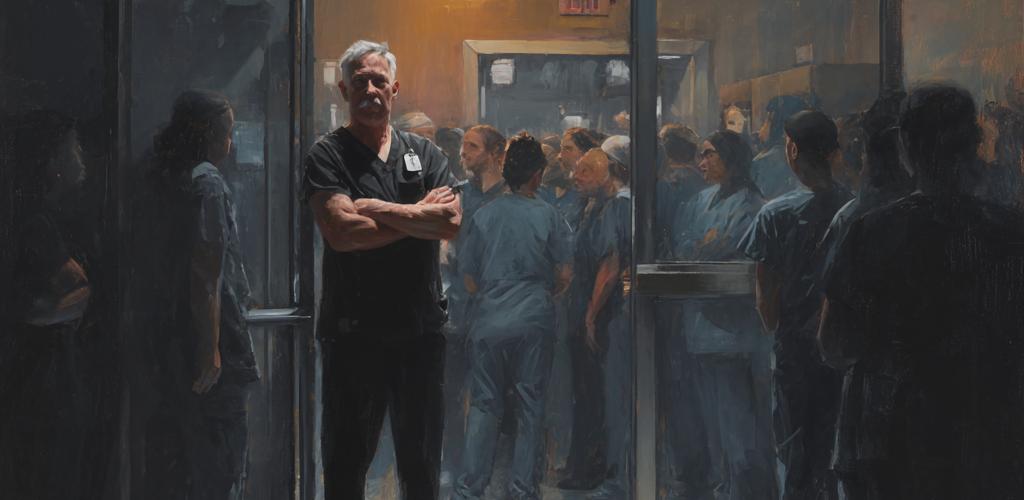
Holmes, a Carter employee since 2009, had been placed on the 180-day program in March 2024 as a pathway back to a Phlebotomist-2 role he had previously held. On April 23, 2024, he posted a message on Facebook inviting coworkers to wear black scrubs on Sundays to express their shared dissatisfaction with Sunday shift assignments, using hashtags including "#Solidarity" and "#TogetherWeCan." Roughly 20 employees participated, and the practice continued in the weeks that followed.
Three weeks after his coworkers first appeared in black scrubs, Holmes was called into an unscheduled meeting with Manager Brandi Wright and Employee Relations Specialist Cindy LaTour. He was shown the Facebook post, asked whether he intended to incite a "rebellion" and questioned about the meaning of "solidarity." Management warned him that it could not guarantee he would avoid discipline, then announced he was being removed from the program, citing blood draw errors and the Facebook post as reasons.
Judge Ringler found that the questioning constituted an unlawful interrogation under the Board's Westwood Healthcare standard. Holmes had been unexpectedly pulled from his normal duties to attend a formal meeting with senior personnel and was explicitly warned of potential discipline, a combination the judge found would reasonably coerce any employee from exercising protected rights. The judge also rejected Carter's argument that Holmes was an unprotected supervisor during the program. His duties at smaller blood drives, broadly directing colleagues to either donor screening or blood draw stations, amounted to routine, interchangeable work performed under continuous Mobile Supervisor oversight. That fell well short of the independent judgment required to confer supervisory status under Section 2(11) of the Act and the Supreme Court's standard in Kentucky River Community Care v. NLRB.
Applying the burden-shifting framework from Wright Line, Ringler found that the General Counsel established its prima facie case through three elements: protected activity in the form of the Facebook post, employer knowledge demonstrated by management raising the post at the meeting, and animus evidenced by the interrogation itself, the explicit linkage of the post to Holmes' removal and the close timing between the protest's spread and his ouster from the program. Carter failed to overcome that showing. The company offered no persuasive explanation for why it dismissed Holmes fewer than two months into a six-month program, particularly given that a comparable employee, Guadalupe Pichardo, who had made similar errors and engaged in no protected activity, was given a full four months under her own program before any adverse action was taken. The judge also drew an adverse inference from Carter's decision not to call Mobile Supervisor Letisha Chatman, Holmes' direct supervisor, whose largely favorable evaluations of his progress in the weeks before his removal would have been directly relevant to the company's performance defense.
The ruling orders Carter to make Holmes whole for his unlawful removal, expunge any reference to the program removal from his personnel file and post a notice to employees affirming their rights under the Act for 60 consecutive days. Because Holmes had resigned from Carter before the hearing and no constructive discharge was alleged, the make-whole remedy does not appear to extend to lost wages, though the parties may address that question during the compliance phase.
Key Points
- Holmes organized a coordinated workplace demonstration via Facebook in April 2024, calling on coworkers to wear black scrubs on Sundays to signal their dissatisfaction with Sunday shift assignments; roughly 20 employees participated and the practice persisted.
- Three weeks after the protest took hold, management called Holmes into an unscheduled meeting, questioned him about the post's intent and removed him from his six-month Leadership Development Program fewer than two months after it began.
- The ALJ found both an unlawful interrogation and an unlawful removal, crediting Holmes' account over the testimony of the company's manager and human resources representative, whom the judge found less than candid.
- Carter's argument that Holmes held supervisory status during the program and was therefore unprotected by the Act was rejected; his duty assignments were routine, tightly overseen and required no meaningful independent judgment.
- A comparable employee with no protected activity was given four months to demonstrate improvement under a similar program despite committing analogous errors, a disparity the judge cited as direct evidence of pretext.
- Carter's failure to call Holmes' direct supervisor, who had reported favorably on his performance in the weeks preceding his removal, drew an adverse inference against the company.
- The Act's protections extend to non-union, private-sector employees and cover off-duty social media activity when that activity constitutes concerted action over working conditions.
Primary Source Author: Robert A. Ringler, Administrative Law Judge
Primary Source: Carter BloodCare and Steven Holmes, Case 16-CA-345182, JD(SF)–12–26 (May 29, 2026)
Primary Source Link: https://www.nlrb.gov/case/16-CA-345182
Supplemental References
- Westwood Healthcare Center, 330 NLRB 935 (2000) — NLRB unlawful interrogation standard
- Kentucky River Community Care v. NLRB, 532 U.S. 706 (2001) — supervisory status test
- Meyers Industries (Meyers II), 281 NLRB 882 (1986) — concerted activity standard
- Wright Line, 251 NLRB 1083 (1980) — burden-shifting framework for protected activity cases
- NLRB and Social Media: Employer Rights and Employee Protections (Boston Bar Association, 2026)
- NLRA Social Media Guidance for Employers (Bradley, 2025)